
Prepare to witness a breathtaking celestial event as the night sky transforms into a celestial stage on Friday. A lunar eclipse will grace our skies, casting a mesmerizing shadow upon the moon, while an extraordinary planetary alignment will unfold, offering a rare glimpse of seven celestial bodies dancing in harmony.
The Lunar Eclipse: A Celestial Shadow Play
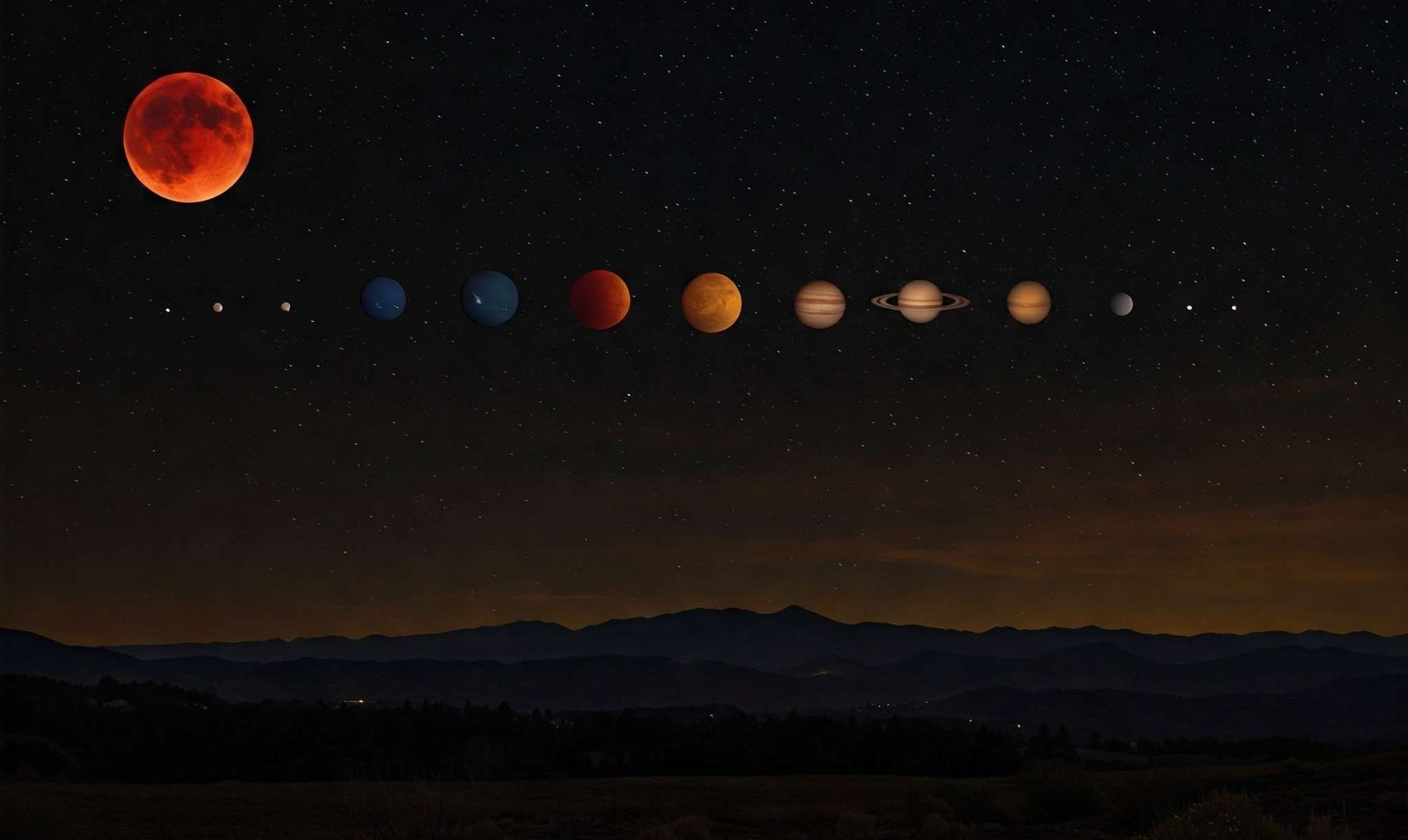
As the Earth positions itself precisely between the sun and the moon, a lunar eclipse will occur, painting the moon in a dramatic, coppery hue. This phenomenon, often referred to as a “blood moon,” is a result of sunlight filtering through Earth’s atmosphere, casting a reddish glow upon the lunar surface. The eclipse will offer a captivating spectacle for skywatchers, inviting them to marvel at the interplay of light and shadow in the cosmos.
A Planetary Dance: Seven Celestial Bodies Align
Adding to the celestial drama, a remarkable planetary alignment will unfold, with seven planets – Mars, Jupiter, Uranus, Neptune, Mercury, Venus, and Saturn – gracing the night sky in a breathtaking display. These celestial bodies will appear to form a diagonal line across the heavens, offering a rare opportunity for stargazers to observe multiple planets simultaneously. The alignment will create a celestial tapestry, showcasing the intricate dance of these celestial bodies as they traverse their orbits around the sun.
A Night for Stargazers and Skywatchers
This celestial event promises to be a night of wonder and awe for stargazers and skywatchers alike. As the lunar eclipse unfolds, casting its reddish glow upon the moon, the aligned planets will add to the spectacle, creating a celestial masterpiece. The combination of these two celestial phenomena will offer a unique opportunity to witness the grandeur and harmony of the cosmos.
Tips for Observing the Celestial Event
To make the most of this extraordinary celestial event, it is advisable to find a location away from city lights and light pollution, where the sky is clear and dark. A pair of binoculars or a small telescope can enhance the viewing experience, allowing for a closer look at the lunar eclipse and the aligned planets. Remember to dress warmly and be patient, as celestial events often unfold at their own pace.
A Reminder of Our Place in the Cosmos
This celestial event serves as a reminder of our place in the vast expanse of the cosmos. As we gaze upon the lunar eclipse and the aligned planets, we are reminded of the intricate dance of celestial bodies, the vastness of the universe, and our own small but significant place within it. Let us take this opportunity to appreciate the beauty and wonder of the cosmos, and to ponder our place within this vast and awe-inspiring universe.
FAQs
Q: When will this celestial event occur?
A: The lunar eclipse and planetary alignment are expected to occur on Friday night.
Q: What is a lunar eclipse?
A: A lunar eclipse happens when the Earth passes directly between the Sun and the Moon, casting a shadow on the Moon.
Q: Why does the Moon turn red during a lunar eclipse?
A: Sunlight is filtered through Earth’s atmosphere during a lunar eclipse. This filtering scatters away shorter wavelengths of light (like blue and green) and allows longer wavelengths (like red and orange) to pass through. This is why the Moon appears reddish during a total lunar eclipse.
Q: What planets will be visible during the alignment?
A: Seven planets are expected to be visible: Mars, Jupiter, Uranus, Neptune, Mercury, Venus, and Saturn.
Q: Will I be able to see all the planets with the naked eye?
A: Some planets, like Mars, Jupiter, and Venus, will be visible to the naked eye. However, Uranus, Neptune, and Mercury may be more difficult to spot without the aid of binoculars or a telescope.
Q: What is the best way to observe this event?
A: * Find a location away from city lights and light pollution with clear skies. * Use binoculars or a telescope for a better view, especially of the fainter planets. * Be patient and allow your eyes to adjust to the darkness.
Q: How often do lunar eclipses and planetary alignments occur?
A: Lunar eclipses occur a few times a year, but total lunar eclipses are less frequent. Planetary alignments are also relatively rare events.
Q: Is there any special significance to this particular celestial event?
A: While not inherently more significant than other such events, this combination of a lunar eclipse and a planetary alignment offers a unique opportunity to witness a spectacular display of celestial bodies.
Q: Are there any safety precautions to consider?
A: Never look directly at the Sun, even during an eclipse. Use proper eye protection if using binoculars or a telescope. Be aware of your surroundings and take precautions against any potential hazards.