

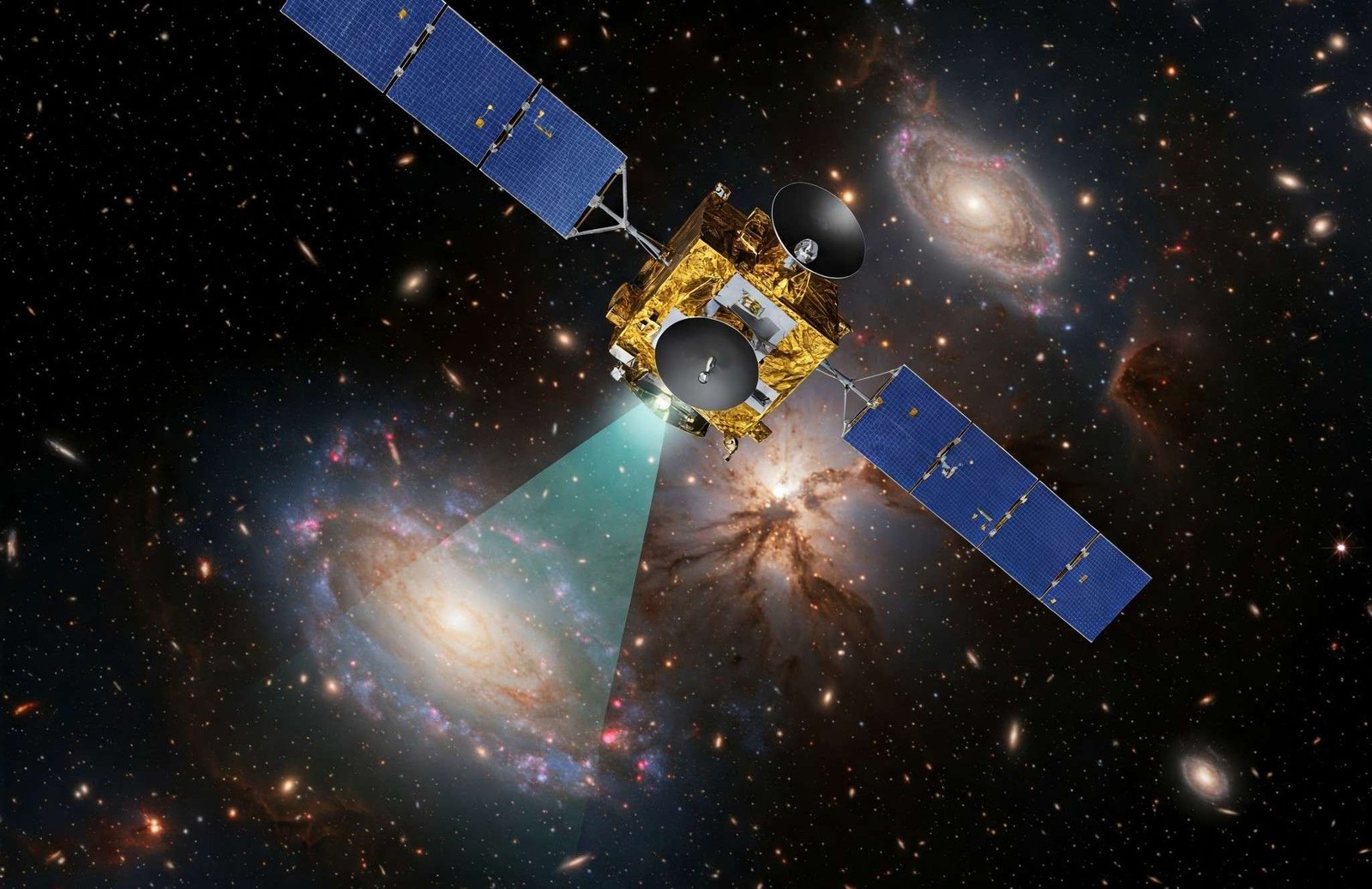
After a series of patiently navigated delays, NASA’s SPHEREx mission has successfully launched, signaling a new era in our exploration of the universe. This ambitious project, the Spectro-Photometer for the History of the Universe, Epoch of Reionization, and Ices Explorer, is poised to create a comprehensive map of 450 million galaxies, utilizing an innovative approach that will observe the cosmos in a staggering 102 distinct wavelengths of infrared light. This unprecedented level of spectral resolution promises to unlock secrets about the universe’s origins, its composition, and the potential for life beyond Earth.
Unveiling the Universe’s Deepest Mysteries: Cosmic Inflation and Beyond
SPHEREx’s primary mission is to peer into the early universe, specifically targeting the epoch of cosmic inflation. This brief but crucial period, occurring moments after the Big Bang, saw the universe expand exponentially. By meticulously mapping the distribution of galaxies and analyzing the subtle variations in their infrared light, SPHEREx will provide invaluable data to test and refine current cosmological models. Scientists hope to uncover the fingerprints of inflation, shedding light on the forces that shaped the universe as we know it.
Beyond cosmic inflation, SPHEREx will address other fundamental questions. It will explore the process of reionization, when the first stars and galaxies ionized the neutral hydrogen that permeated the early universe. By studying the spectral signatures of distant galaxies, researchers can reconstruct the timeline of this crucial transition. Moreover, SPHEREx will investigate the distribution of dark matter, the mysterious substance that makes up a significant portion of the universe’s mass but does not interact with light. The gravitational effects of dark matter will be inferred from the large-scale distribution of galaxies, providing insights into its nature and distribution.
A Search for the Building Blocks of Life: Ices and Organic Molecules
SPHEREx’s mission extends beyond the extragalactic realm. It will also explore our own Milky Way galaxy, searching for water ice and other organic molecules in interstellar dust clouds. These clouds are the birthplaces of stars and planets, and understanding their composition is crucial for understanding the origins of life. The 102 different wavelengths of infrared light that SPHEREx can detect allow scientists to identify the unique spectral signatures of various molecules, including water, carbon monoxide, and other organic compounds. By mapping the distribution of these molecules, SPHEREx will provide clues about the potential for habitable environments throughout our galaxy.
Technological Innovation: A New Approach to Cosmic Mapping
SPHEREx’s unique capabilities stem from its innovative design. Unlike traditional space telescopes that focus on specific targets, SPHEREx will survey the entire sky repeatedly. Its wide-field camera and spectrograph will capture images and spectra of millions of galaxies simultaneously, creating a comprehensive database of cosmic objects. The use of 102 different wavelengths of infrared light is a significant advancement over previous missions, allowing for more detailed and accurate measurements of the properties of galaxies and interstellar clouds.
The spacecraft’s design also incorporates advanced cooling systems to maintain the detectors at extremely low temperatures, maximizing their sensitivity to infrared light. This is crucial for detecting the faint signals from distant galaxies and cold interstellar clouds.
Overcoming Delays and Paving the Way for Discovery
The SPHEREx mission faced a series of delays, primarily due to technical challenges and the need for meticulous testing and verification. However, these delays have ultimately ensured the mission’s success, allowing engineers to refine the spacecraft’s design and address potential issues. The successful launch is a testament to the dedication and expertise of the teams involved.
A Collaborative Effort: Sharing Data with the Global Scientific Community
The data collected by SPHEREx will be made publicly available to the global scientific community, fostering collaboration and accelerating the pace of discovery. Astronomers and astrophysicists worldwide will be able to access the SPHEREx database, using it to conduct their own research and contribute to our understanding of the universe.
SPHEREx represents a significant leap forward in our exploration of the cosmos. Its unique capabilities, ambitious scientific goals, and innovative design promise to deliver groundbreaking insights into the universe’s origins, its composition, and the potential for life beyond Earth. As SPHEREx embarks on its journey, we eagerly anticipate the new discoveries that will reshape our understanding of the universe and our place within it.
FAQs
Q: What is SPHEREx?
A: SPHEREx (Spectro-Photometer for the History of the Universe, Epoch of Reionization, and Ices Explorer) is a NASA space telescope designed to map the entire sky in 102 different wavelengths of infrared light.
Q: What are the main goals of the SPHEREx mission?
A: The main goals are to:
- Study cosmic inflation and the early universe.
- Explore the epoch of reionization.
- Search for water ice and organic molecules in the Milky Way.
- Map the distribution of galaxies and dark matter.
Q: How many galaxies will SPHEREx map?
A: SPHEREx will map approximately 450 million galaxies.
Q: What makes SPHEREx unique?
A: SPHEREx is unique because:
- It will observe the entire sky repeatedly.
- It uses 102 different wavelengths of infrared light, providing unprecedented spectral resolution.
- It will create a comprehensive database of cosmic objects.
Q: What is cosmic inflation?
A: Cosmic inflation is a period of rapid expansion that the universe underwent shortly after the Big Bang.
Q: What is the epoch of reionization?
A: The epoch of reionization is the period when the first stars and galaxies ionized the neutral hydrogen that permeated the early universe.
Q: Will SPHEREx find life on other planets?
A: SPHEREx will search for the building blocks of life, such as water and organic molecules, in interstellar clouds. While it won’t directly find life, it will provide clues about the potential for habitable environments.
Q: How long will the SPHEREx mission last?
A: The primary mission is planned for two years.
Q: Where will the data from SPHEREx be available?
A: The data will be made publicly available to the global scientific community.
Q: What type of technology is used in SPHEREx?
A: SPHEREx uses a wide-field camera and spectrograph, as well as advanced cooling systems to maintain its detectors at very low temperatures.
Q: What is the significance of using 102 different wavelengths of infrared light?
A: Using 102 different wavelengths allows scientists to identify the unique spectral signatures of various molecules and to obtain more detailed and accurate measurements of the properties of galaxies and interstellar clouds.